
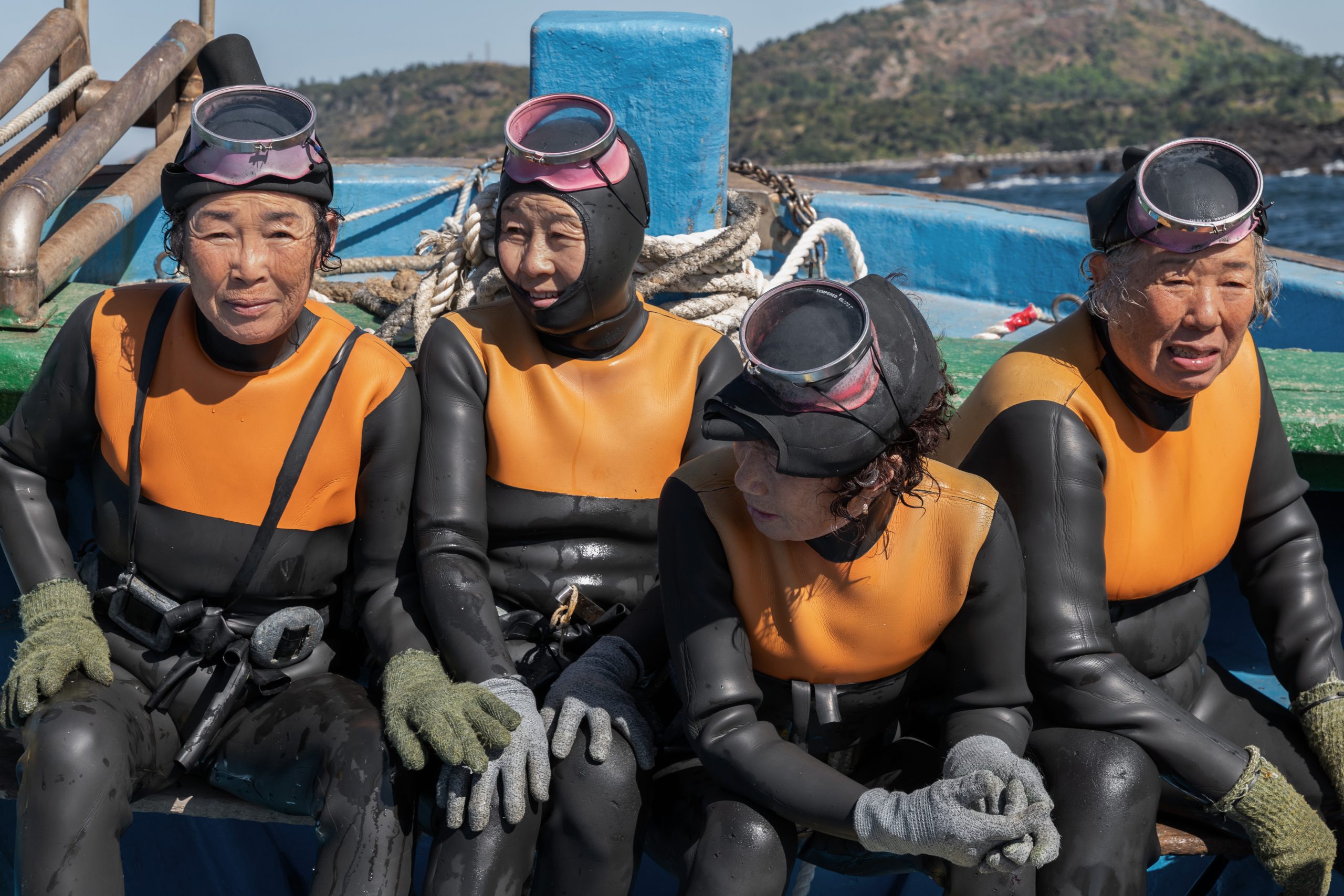
The Last of the Sea Women
- Director
- Sue Kim
- Languages
- Korean, English (with English subtitles)
- Release
- 2024
- Runtime
- 86 min
- Waters and Lands
- Korea Strait; Jeju Island [Korea]
Synopsis
In The Last of the Sea Women, director Sue Kim turns her lens to Korea’s haenyeo: women who free-dive in the Korea Strait, harvesting seafood at depths of up to 20 meters. Kim offers a lively portrait of several haenyeo—now in their seventies, eighties, and nineties—as they continue diving to sustain themselves and their families, despite painful histories of social marginalization and new threats to their way of life. When the Japanese government announces a plan to release treated radioactive water from the Fukushima nuclear power plant into the Pacific Ocean, haenyeo across Korea come together in protest. As Kim follows their efforts, she juxtaposes the power of local organization with the limits of global governance, particularly when it comes to the challenges of regulating ocean pollution across international boundaries. The Last of the Sea Women offers an ultimately hopeful reflection on intergenerational solidarity, celebrating the significance of women’s embodied knowledges and collective action.
Director Bio
Raised in Detroit, Michigan, Sue Kim is the daughter of Korean immigrants to the United States. Before moving into documentary filmmaking, she studied English Literature at UC Berkeley with a BA in English Literature and spent 20 years as a commercial producer. Her directorial debut, The Speed Cubers (2020), follows the lives of two Rubik’s Cube-solving champions, Max Park and Feliks Zemdegs and the friendship that ensues. She was first introduced to haenyeo on Jeju Island when she was eight years old, on a trip with her family, and The Last of the Sea Women is the result of many years of connection. Kim lives in Portland, Oregon with her son.
Distribution
AppleTV+
Many of the haenyeo wanted to speak about what was happening to the ocean, about the environmental destruction of the marine life that only they could see. Because they’re in the water every single day, year after year. People that are aren’t doing that underwater work can’t really see what’s happening with climate change and global warming and sea pollution, but they can.
Teaching Resources
Half Hour With, dir. 2024. Half Hour With: The Last of the Sea Women (Sue Kim). 30:46.
Jeju Provincial Self-Governing Haenyeo Museum
Hatfield, Samantha Chisholm, and Sun-Kee Hong. 2019. “Mermaids of South Korea: Haenyeo (Women Divers) Traditional Ecological Knowledge, and Climate Change Impacts.” Journal of Marine and Island Cultures 8 (1).
Liboiron, Max, Manuel Tironi, and Nerea Calvillo. 2018. “Toxic Politics: Acting in a Permanently Polluted World.” Social Studies of Science 48 (3): 331–49.
Park, Minu. 2025. “When the Oxygen Mask Becomes Excess: The Ethics of Cultural Preservation and Haenyeo Kitchen’s Food Ecology.” Asian Theatre Journal 42 (2): 472–89.